Led by Rob Cover, Joel Humphries and Adnan Alamri (RMIT Digital Ethnography Research Centre), this project is working with stakeholder organisations to gain insights into the kinds of guidelines for managing, reporting and coping with scam messages.
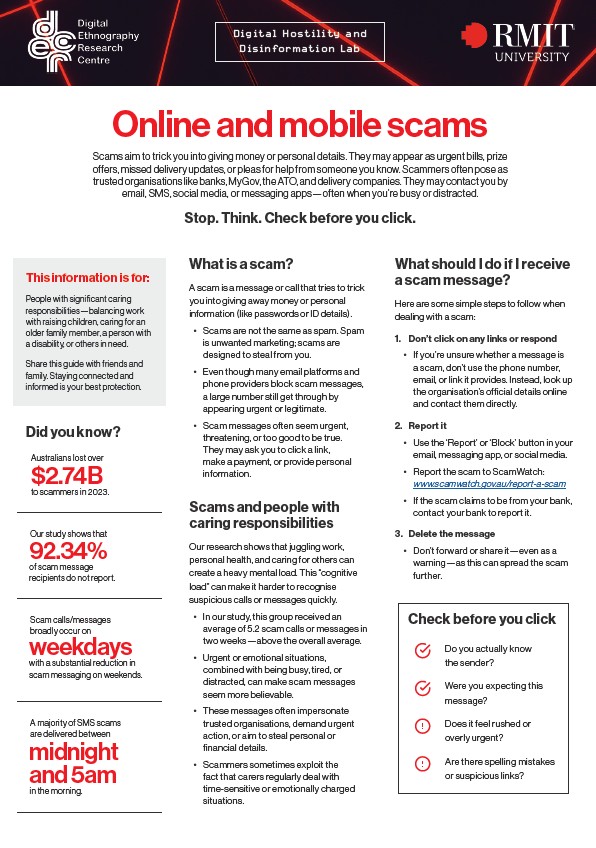
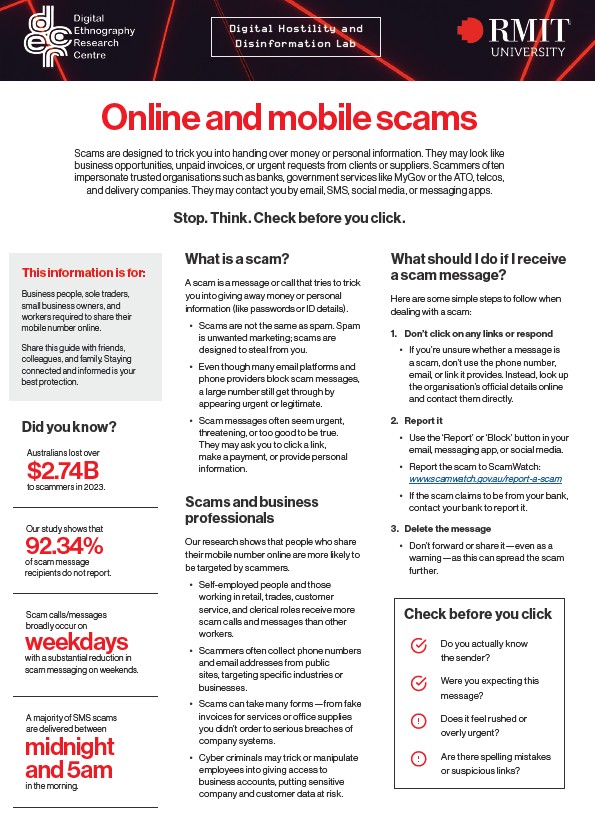
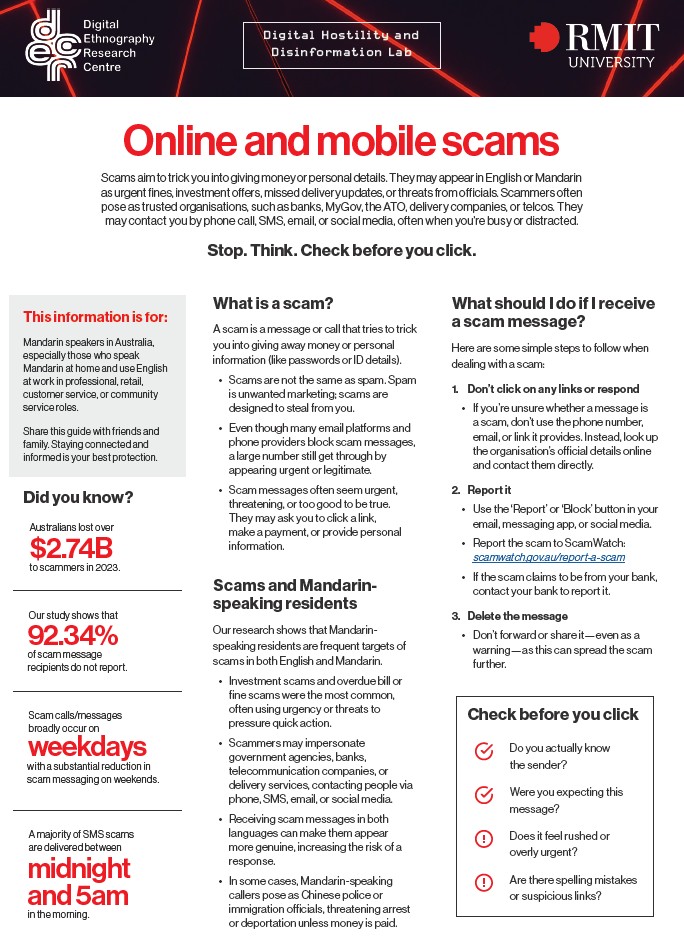
Australians lost $2.74 billion to scammers in 2023.
Although scam communication is normalised today, there is an urgent need to work with trusted organisations that support vulnerable groups to help protect from scams. The Australian government mechanism for addressing scam calls/messages is to collect reports (via ScamWatch and telcos), however our study demonstrated that (i) reporting is not reducing the cost and risk of scams, and (ii) 92.34% of scam message recipients do not report due to a lack of information and a cumbersome reporting process.
Our studies on digital and mobile scam messaging have revealed a number of groups more vulnerable to high rates of scam messaging, including particularly
- Users with significant caring responsibilities (e.g., people who care for a relative with a disability or young children in the household);
- Business people whose work requires them to share their mobile number online;
- Older Australians (including retirees)
- Mandarin-speaking residents in Australia.
Evaluating guidelines (Targeted Scam Fact Sheets 1-4)
To understand the needs of different sectors, we would like to ask organisations that support the four groups to do a very brief evaluation of the quality and form of our draft guidelines. Each guideline has been written with a target population in mind (but you are welcome to review and evaluate guidelines outside your sector area).
We are grateful for any feedback at all, and will endeavour to incorporate it into future versions to help in the reduction of scams in Australia.
The evaluation should take no more than 5-6 minutes to complete. To complete: please click the bold heading below to read the 2pp guideline, and then the brief survey link directly below the heading.

 RMIT Digital Hostility and Disinformation Lab (@ The Digital Ethnography Research Centre)